I am selling my Gordet oboe. This has been my oboe for the last 10 years. Gordet is a stamped oboe made by Hans Kreul in Germany, this has created a problem in finding a date of production. This oboe was made some time in the 70s.

I have been playing the oboe in the San Francisco area for a few years, but recently it has been sitting in my closet and so I’ve decided to downsize my instrument collection. The oboe is grenadilla wood without any cracks and has a 3rd octave key, low Bb, split D key, C#-D# connection, low B-C# connection, and left F.

Gordet Obobe

I bought a Wiseman bassoon case three years ago to replace my Fox bassoon case. My Fox professional case was such a hassle to commute with and walk  around San Francisco with that I had to buy a replacement. The Wiseman case appealed to me on an esthetic level with the crushed velvet interior and the leather exterior. I have gotten so many compliments about this case since I’ve been using it, most people just don’t believe that a whole bassoon fits inside!

Wiseman Bassoon Case


My concern was that that the materials wouldn’t hold up for a few years. The case is made from wood, dense foam, crushed velvet, leather and velcro. For the most part it has all held up well, with the exception of the velcro on the handle. The Velcro that lines the edge of the case is doing fine after 3 years of continuous use, but the handles are falling apart.

Wiseman Case

After ripping off the first time I took heavy load thread and reattached the strips. It is falling apart again after about a year. This time around Im going to use a set of snaps.

All in all a great case, they have recently launched carbon fiber cases and a bassoon/contrabassoon combination case.

wiseman contrabassoon case

San Francisco is a hub of new music and small ensembles. One of these newly formed groups, is a chamber orchestra called Elevate Ensemble. This is a unique ensemble in that they perform rare works that don’t receive enough attention. Their next show is on October 10 at 8pm at the San Francisco Conservatory of Music.  Come to hear..


Hanns Eisler     Nonet no.1

Walter Piston     Divertimento

Danny Clay     Bethlehem Triptych

Richard Wagner     Siegfried Idyll

Tickets available for $15 at eventbrite.com


Elevate Ensemble

Tax deductible contributions with AWESOME PERKS can be made at hatchfund.org


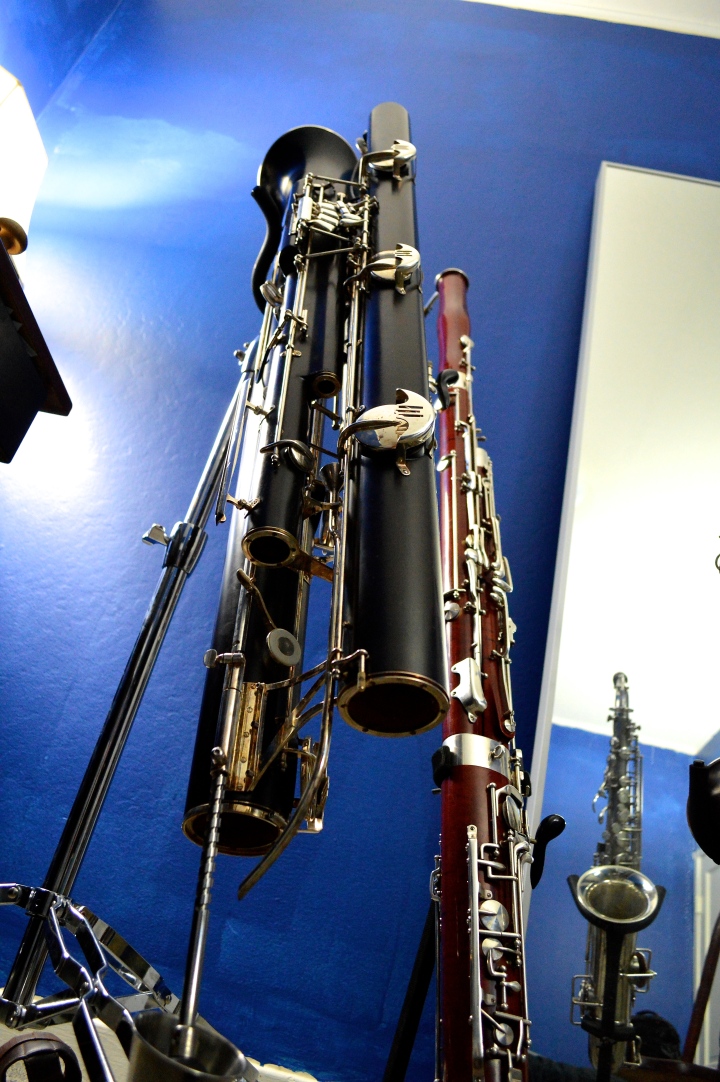
Heckel Bassoon


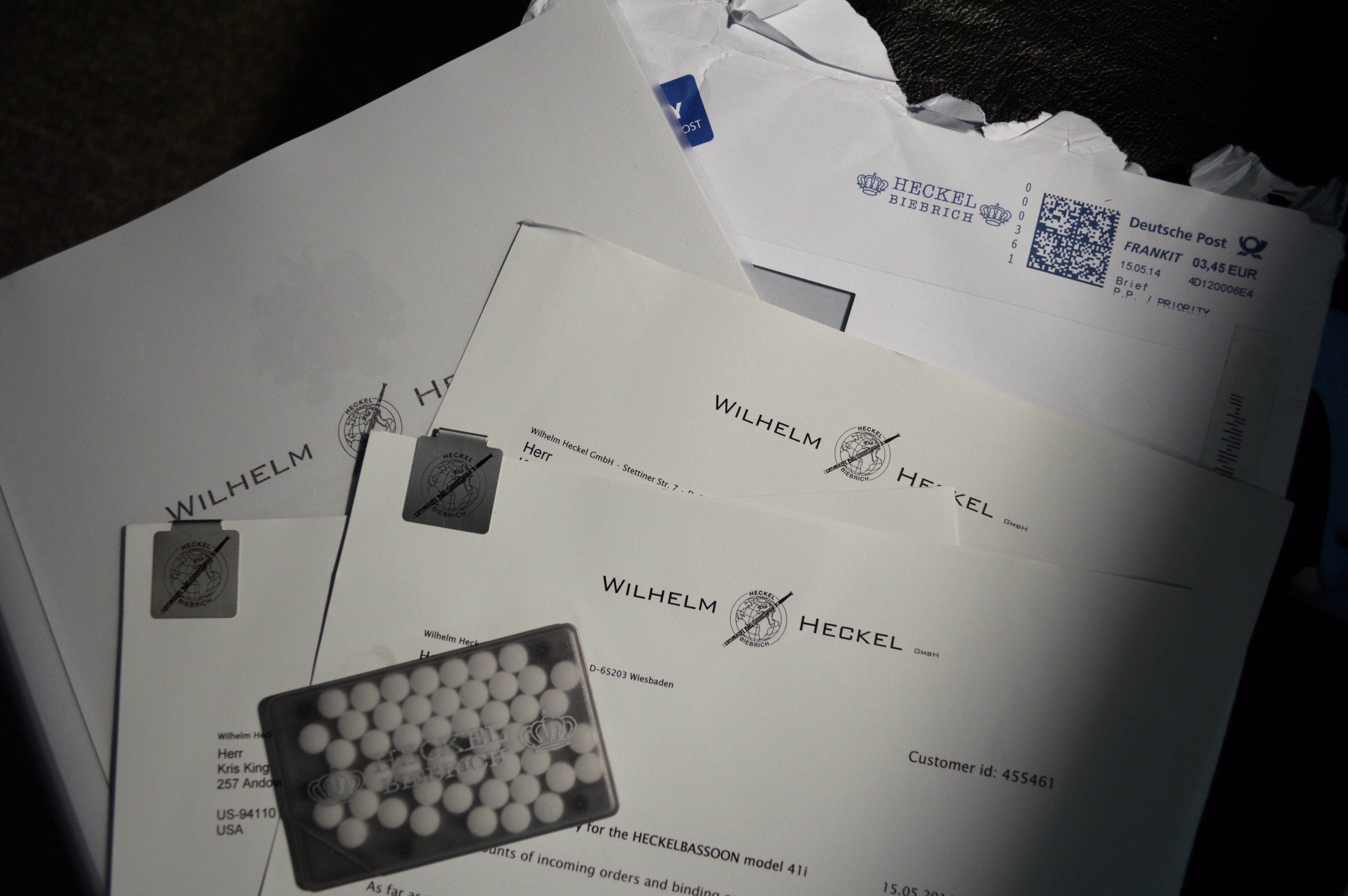
A few months ago I had my first correspondence with Heckel. I am looking for my next bassoon and I have play tested a few new Heckels that I really liked. After emailing back and forth to find out what options were possible, they sent me a mail packet with an order form. I thought that I knew the bassoon options that I wanted, but seeing all of the options layer out on a list was overwhelming!

I am going over the new instrument piece by piece to figure out how it will all look together. I don’t EVER want to buy another instrument after this so I need it to have everything on it that I would need for the rest of my career. Like how high E was a standard key for a while but in the past few years the high F key is becoming normal.  I haven been able to make decisions about most things, except for the bell options. The French and Italian bells look great and then the gentleman vs. regular bell lengths…

Italian Bell Gentleman (current favorite)

Italian Bell Heckel

German Bell Gentleman

German Bell Heckel

French Bell Regular

French Bell Heckel

I have entered the limbo phase of my life. I am out of school and practicing all day just waiting for auditions to come up. I’m becoming a full time audition jockey and taking everything that opens. After taking auditions for a few years I realized that I have a problem retaining my audition performance. I can remember the mistakes that I made for a few days, but after months, when I am at the next audition, I try to remember how my last audition went and I have no idea.

So I decided to start an audition journal at my grad school auditions two years ago. Its just a regular composition notebook that I keep in my excerpt binder. I get really into it during an audition and try to document everything possible. Everything from how much sleep I got the night before the audition, how much coffee that I had (for nervous people caffeine can cause shaky hands) and how the audition actually went. Before I even start packing up my instruments I start jotting down what mistakes happened and how I recovered from mistakes.

I have been recommending this to all of my friends who are taking auditions. Even just for posterity’s sake, to look back and laugh at a terrible audition disaster. This is also the best way to record the experience and know in advance how you will react in future auditions.

From my own personal audition journal I found a few patterns evolving. I don’t have stage fright, so I don’t get nervous on stage or during a performance. I do get nervous the morning of an audition but it’s based on logistics.

Like… do i have the perfect reed? did i remember my reeds? do i have the correct check in time? correct date? did i warm up enough? too much? etc.

I also skip breath marks that I have specifically written in. As if after months of practicing this piece of music and logically making a decision of where to breathe, on the spot I have a better solution. So then I am forced to take a breath in a spot that makes no sense whatsoever and is completely jarring.

So outside of the obvious “having mock auditions for friends, family, and teachers” and “recording yourself” and “find many different recordings of the pieces” I would say that the audition journal is the best way to personally track and control yourself in audition settings.


The technology and resources available for making musical instruments is at an all time high. I was very impressed and surprised when I visited the Fox factory and was able to see what went in to making an instrument. I have found some interesting videos on instrument production that range from small scale productions to large factories. This is the whole orchestra in score order being made. Sorry Violas.

Flute

Oboe

Clarinet

Bassoon

Trumpet

French Horn

Trombone

Tuba

Violin

Viola

Cello

Bass

Harp

Sax


Large woodwind instruments have problems with water and condensation from regular playing. Not to mention the amount of playing that occurs in the lead in to a recital or audition. Contrabassoons are especially susceptible to water damage because they do not come apart to be swabbed, and most players cannot take their contras apart without damaging the seal when putting it back together.

Just last week I was talking to a woman who had bought a Mollenhauer contrabassoon in an estate sale. She bought half of it along with another bassoonist, and they shared it. But after a few months of playing and putting it back into the case one of them developed a cough, and through some sleuthing, found that the contrabassoon was full of mold! They brought it to a repairman who cleaned it out but it was never the same. We all heard about Trombone Lung a few years ago. This stuff can really cause respiratory ailments along the lines of Anthrax.

The best method for keeping a contrabassoon dry is to remove the tuning slide and leave it out on the stand for a few hours after playing. This won’t prevent all problems, on older contras water damage can even be seen on the outside of the instrument, through the lacquer.  The contra’s “wing joint” is the common problem, this is the first piece of wood after the first bend. The danger is mold, and that the mold can damage the seal of the instrument and eat away at the wood of the bore, changing the dimensions.

Contraforte has a bad side and a good side. The bad side is that there is no tuning slide, and so nothing can be opened to help it air out; the good side is the modular design which allows players to take apart their own instruments. I can safely loosen the C-clamps and remove a bend to clean out sections. Recently I removed the second bend for the first time to find that it was lined with mold. The first bore can air dry but after a certain point the circulation doesn’t dry out the entire bore. This means that I need to do regular checks and cleanings at least once every two months.

The best tools for preventing life in an instrument are rubbing alcohol and a dehumidifier. Find a small spray bottle capable of an extremely fine mist, as fine as an aerosol spray. fill it with rubbing alcohol and spray it down the bore when you finish playing and right before you swab (non-contra) The alcohol mist will sterilize the bore and the hard to reach tone holes with the added benefit of evaporating quickly. I even do this to my bassoon before I swab it and put it away. Having a dehumidifier drying out the air makes it difficult for mold and fungi to take hold.
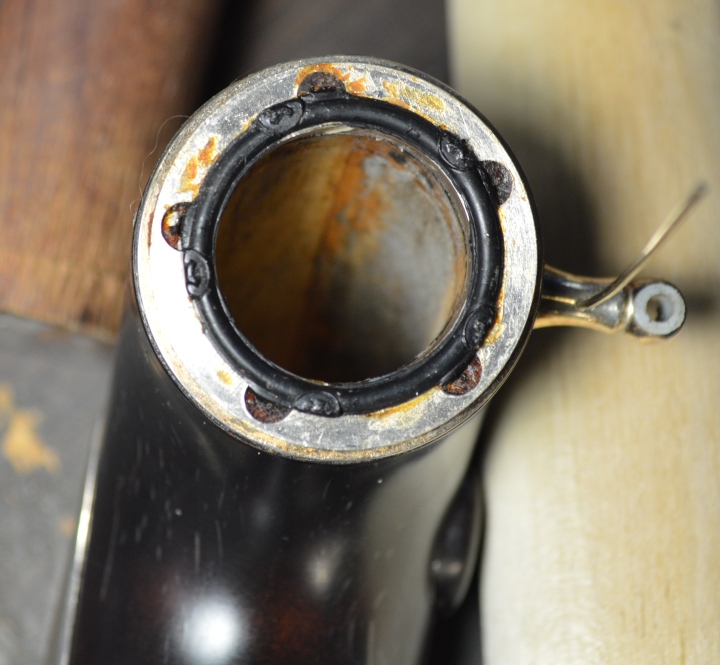
Contraforte


Today I did a large scale cleaning by removing all bends and using a fine sprayer of rubbing alcohol. By spraying sections at a time and swabbing them I killed any mold spores and other microbes living inside.
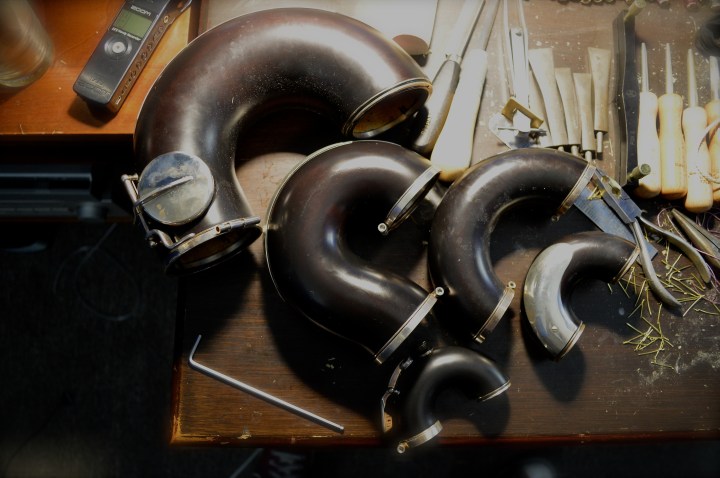
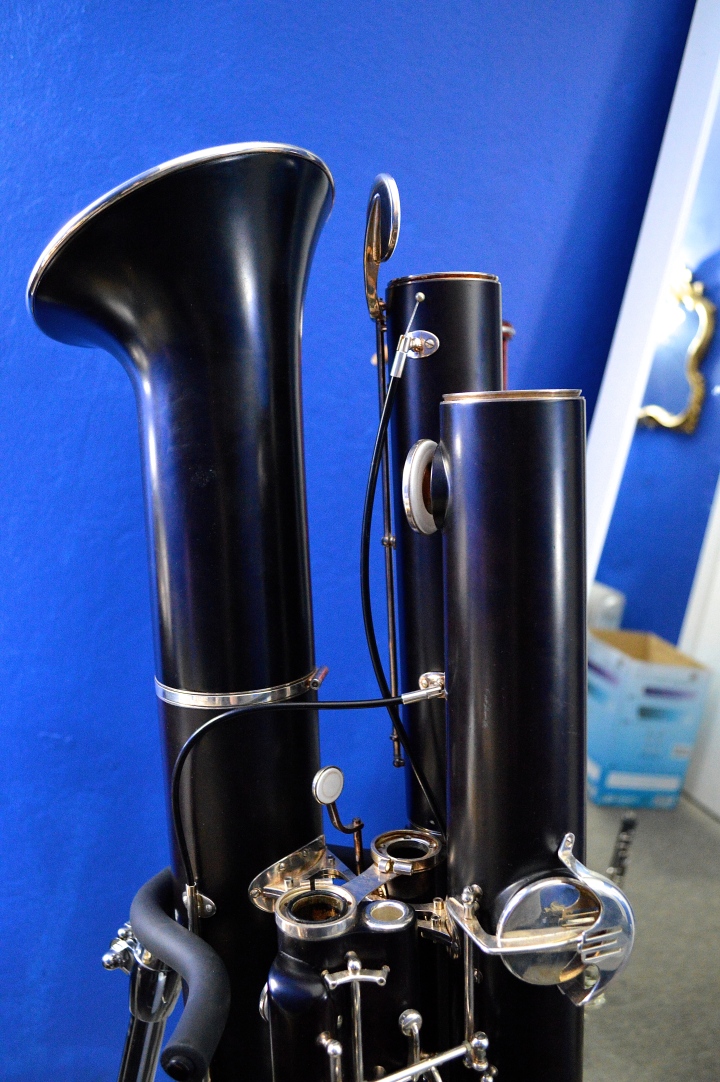
Contraforte Contraforte Contraforte

I have recently invested in a great dehumidifier from Lowes which has improved the air quality. I highly recommend a dehumidifier for woodwind players or doublers. If you can imagine all of the moisture that accumulates in the air from playing multiple instruments and reed making, it makes it hard for things to dry out fully. Especially here in the San Francisco Bay Area there is constant fog and moisture from the sea. I have been keeping my instruments at 45% humidity, this has already stopped my problem of sticky pads.
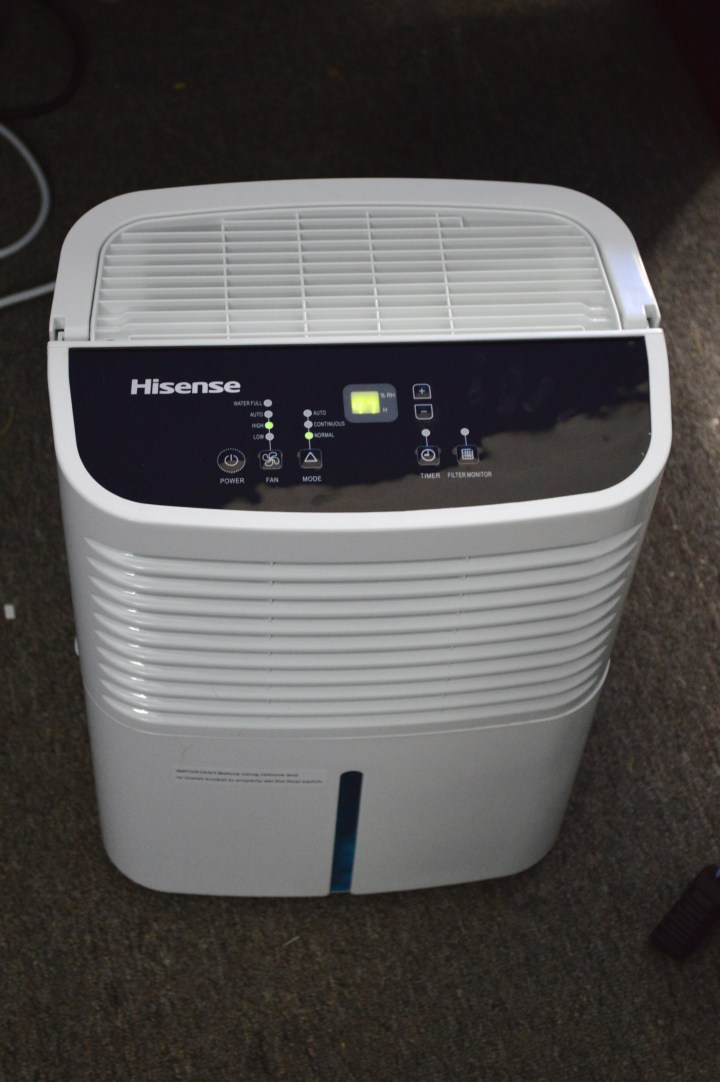

Dehumidifier

With the price for new musical instruments skyrocketing, it’s not surprising that some people have actually gone into building their own instrument! Most of the people I have found who built their own horns don’t actually play but are master carpenters or handymen who are curious. Others are musicians who are testing out different possibilities of their instrument families.

This man made a wooden trumpet out of a home workshop. Although he isn’t a trumpet player, this is a functional piston trumpet.


The Bamboo Sax has been around for a while, I saw one on vacation in 2006


The least embarrassing bassoon related video I could find was of Robin Howell making a bassoon bocal, which would be interesting to try but I don’t think I would trust it!


MY favorite video on youtube right now is of this guy who built his own CONTRABASSOON! It actually sounds nice, has a recognizable scale, and doesn’t look like garbage. I was really amazed when I saw this.


ModernTimes

This last week I had the opportunity to play the film score to “Modern Times” This is one of the final silent films and the last appearance of Charlie Chaplin’s “little scamp” character. Each performance was sold out and the audience was very receptive.

This project was my first time playing a film score along with the film, and it was stressful. The conductor has strict timing to follow and so the musical cues have little prep. He mostly watches the film waiting for certain scene changes and action to start the different orchestra cues. The fun part was playing the bassoon solos which are mostly jokey and loud. there are a few cool english horn solos and  some very fast over the top tempos.