This Metal Contrabassoon is made by Evette & Schaeffer in 1900, this horn uses the french fingering system. It is played using regular modern contrabassoon reeds and plays at modern pitch. I had no idea that metal contrabassoons existed until a former teacher of mine was talking to me about having played on one!
Legere has been making some great bassoon reeds! but they left out us contra players. So this is a video on making plastic reeds from a commonly found item, a Slurpee!
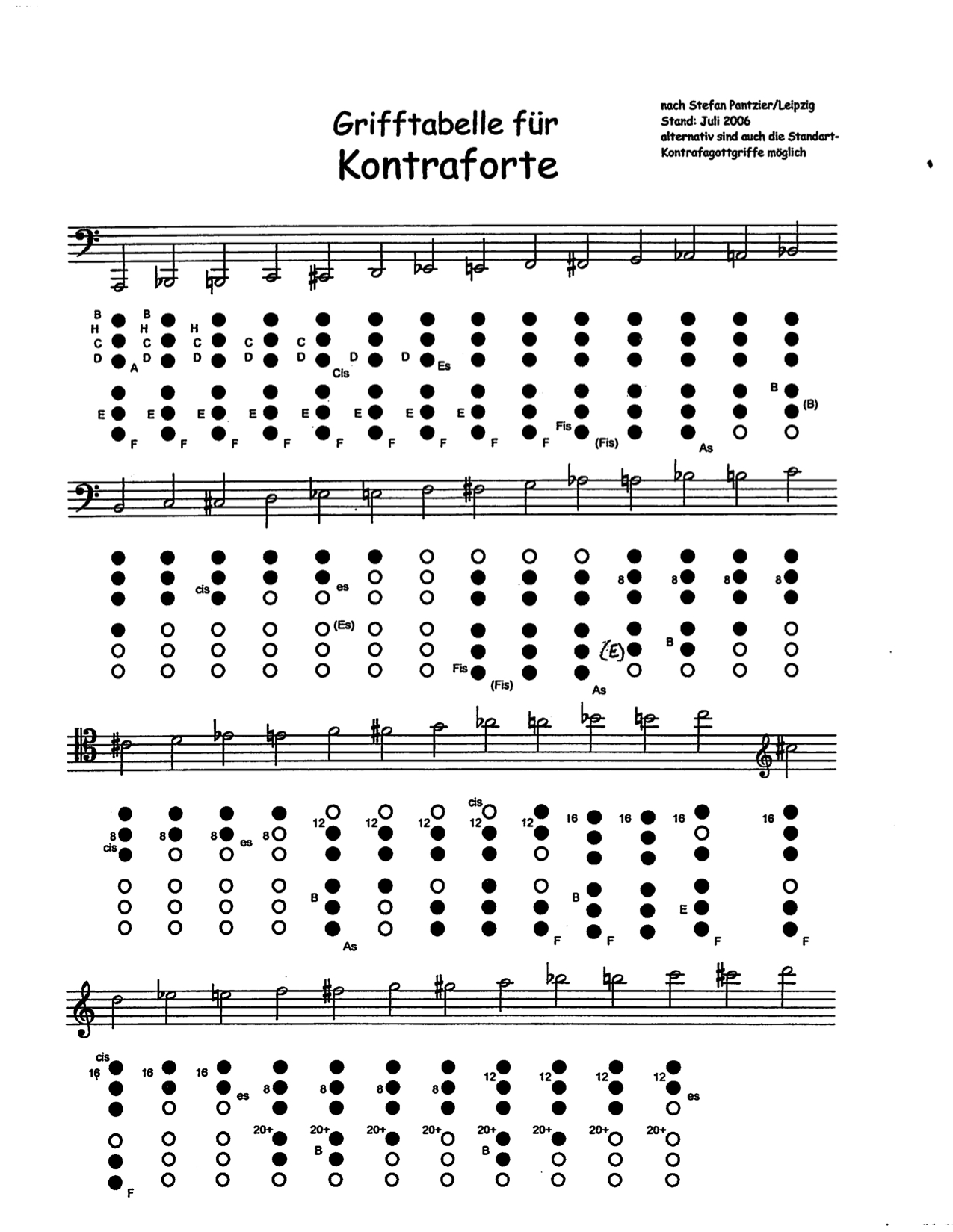
The usable range of the Contraforte is from A0-C5. This is an improvement on the contrabassoon range by a few steps. Although I know some very talented contra players that can play almost as high as any contraforte. Im mostly posting this so that composers are able to hear the timbre change of the different registers.
The Contraforte does not have a dependable high D but it is possible. Here I play the opening bassoon solo from Stravinsky’s Rite of Spring, at actually pitch. I used an extremely thick reed with a lot of resistance.
I tried an experiment last week involving a Green Reed for Contraforte. I just harvested some cane in early January and decided to try to immediately make a reed out of it instead of letting it dry. And this is what turned out! I regular reed that sounded and acted like any other reed but it was fresh green cane and didnt need to be soaked in water before I played on it. The texture was similar to a very hard piece of cane so I had to make this thinner than I would normally. After a few days it started to dry out and warp and is now is playing very sharp. Next I’m going to try this on regular bassoon.
I would suggest trying it to all of the cane harvesters out there!
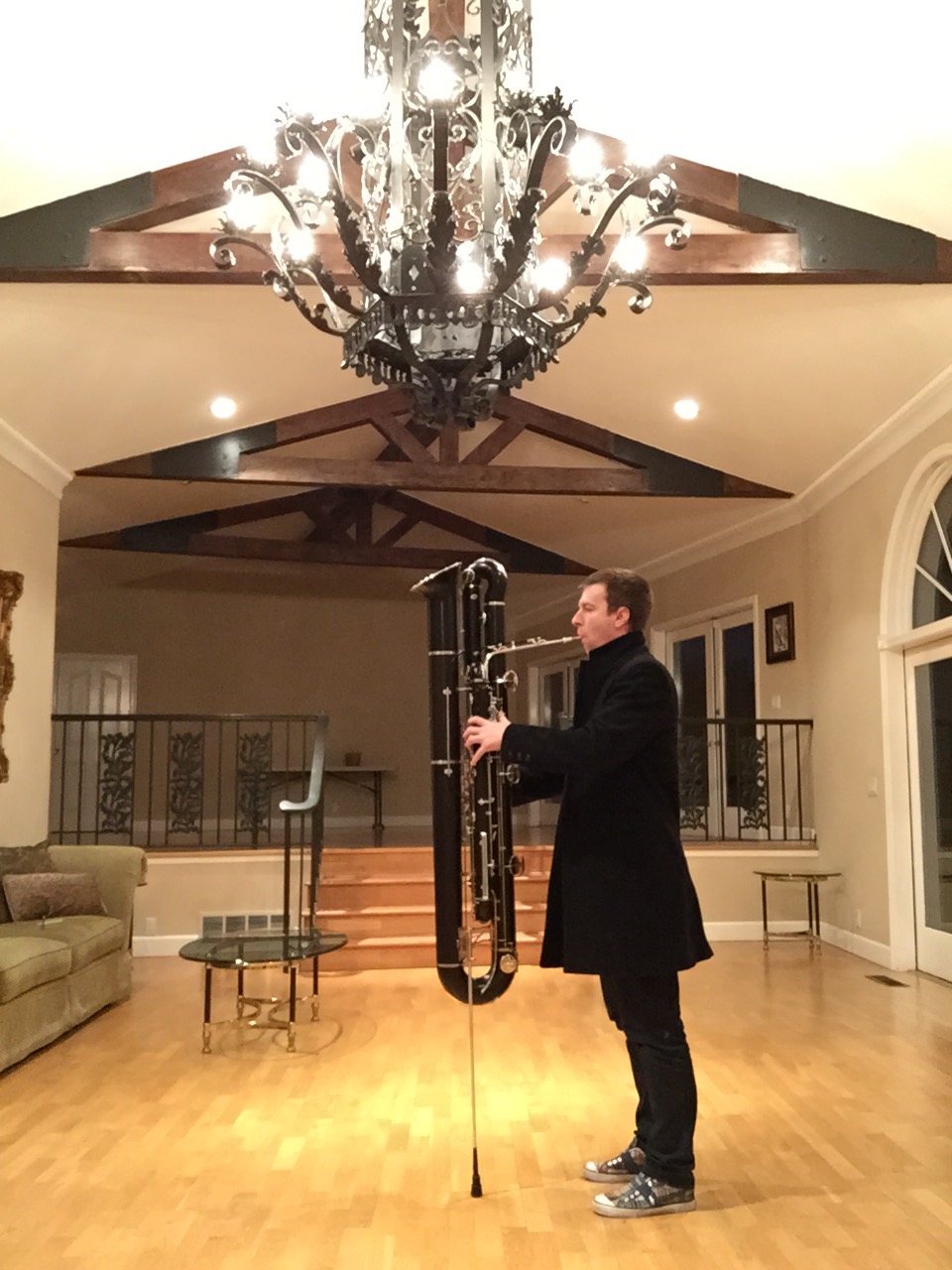
I have been jealous of bass clarinet players and contrabass flute players who are able to perform standing. It adds to the stage presence for certain pieces and is more visually interesting to watch.
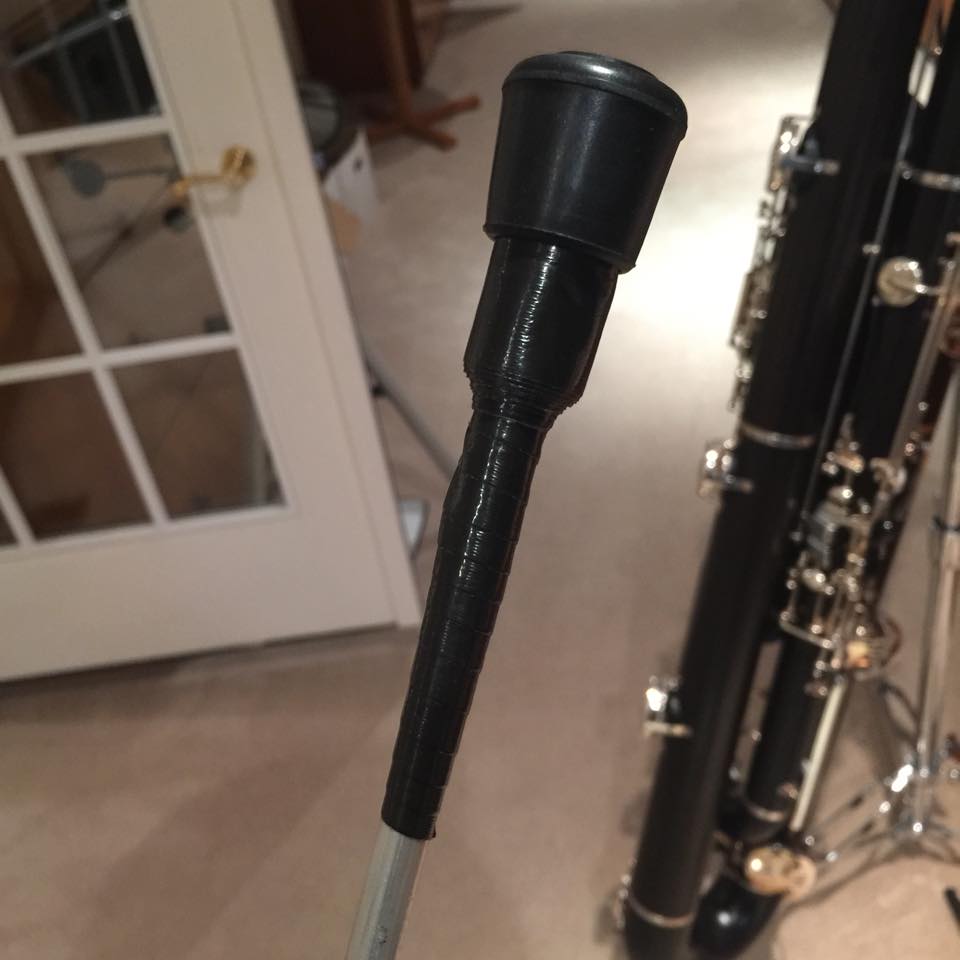
The parts that I used to make this standing peg cost under $10 and I bought it all at Home Depot.
For the Contraforte, the peg used is 3/8 inch so it was easy to find a match. I used an aluminum rod since it aluminum is easier to cut. I have my cordless reciprocating saw,Peg stock, black Duct Tape, a Rubber stopper. After cutting the peg to length based on my height, I wrapped the tape around an end to fit the rubber stop.
The Vonk is a bassoon support system created by Maarten Vonk. The system is designed to be used in place of a seat strap, leg hook, or floor peg and is unique because of it’s design and weight distribution. Essentially there is no weight put on the player’s hands when using the Vonk as long as you adjust it to the correct height. I have been using the Vonk for many years now and really enjoy it. They were popular in the Los Angeles area in the mid 2000s and I know many people who swear by them. I primarily use a seat strap for daily playing, but I bring the Vonk out for days with over 5 hours of playing. For some opera productions there will be a morning service/run through, lunch, and another run through. This is too much playing for me on top of my regular practice, so this system saves my hands.
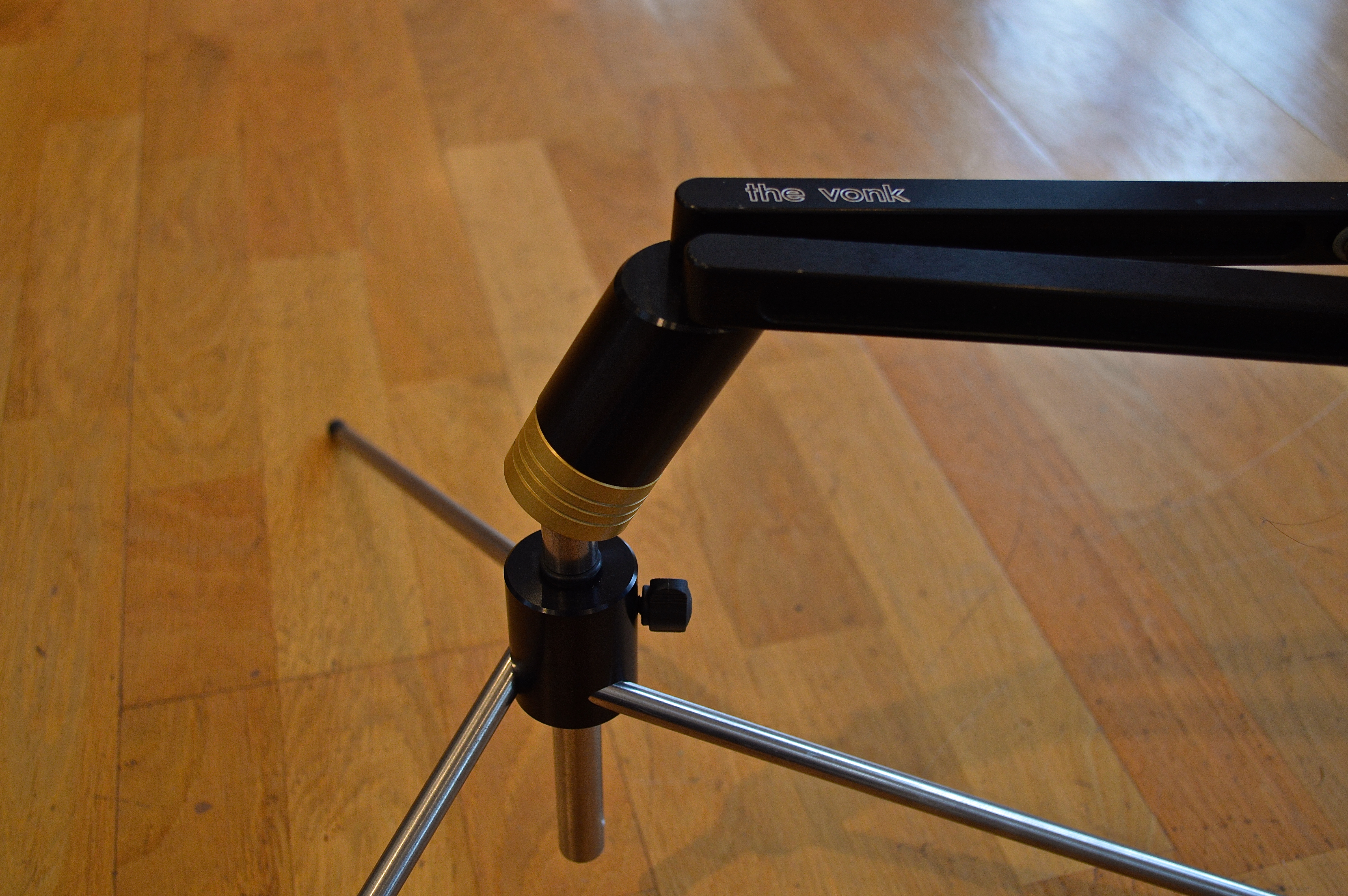
The Vonk has two metal bars that attach to the base tripod. At the other end is a nob used to tighten the boot cap into the clamp. Depending on your bassoon, the boot cap might come loose, so test this area of the bassoon to make sure that you bassoon will stay up. If the boot cap comes loose, the bassoon fill fall off. The clamp tightens at a moderate pressure, too tight might dent the boot cap and too loose might cause the bassoon to slip. I have never had a problem with this. I play on a Fox 601 and it is very sturdy, however I can see how this could be a problem for some bassoons.
The real piece of engineering that sets this system apart is the tight ball in socket joint. This joint is the counterbalance for the weight of the bassoon. With the gold section engaged the Vonk becomes a bassoon stand. It disengages the ball in socket joint and so the bassoon stands vertical (see top photo)
When the gold section is brought down, the joint it engaged. This gives a large range of motion and is adjustable. Not only is the position and angle of bassoon changeable but also the height, so it is usable with most chair heights. When the system in engaged and in position, the bassoon just floats in front of you. The Vonk is available online at Bassoon.com
December 2013 was a very important month for me because of the purchase of a Contraforte. This horn was owned by Lewis Lipnick of the National Symphony in Washington D.C. (who is an amazing person and an amazing player) When I bought it, I drove my little Prius from San Francisco to Washington DC to pick it up and drive it back. Now that I have had it for a year I think I am in a better place to talk about my experience with this instrument. My reason for writing this is the same reason for this entire website, basically consumer reports. So many cool new gadgets have been coming out in the woodwind world recently without much user reviews. When I spend money on new equipment I do research to see how it is received by players before I decide to purchase it.
Origin Story (skip this)
In my undergraduate studies at the San Francisco Conservatory I played a little contrabassoon here and there as needed but it never stuck with me. Then after graduating I went and played contra with the San Luis Obispo Symphony for a year. The symphony had an Amati contrabassoon that I was allowed to borrow and keep in my possession full time and this is when I started getting into contra. By having a contra at my house that I didn’t have to share, I put in some practice hours and messed around with reeds. I ended up really liking contrabassoon and decided to go back to the conservatory to study contra with Steve Braunstein of the San Francisco Symphony (another amazing person and amazing player) I was using the SFCM Fox contra which is in need of service and a better bocal so I was frustrated. I was looking around the used contrabassoon market all summer and fall looking for anything worthwhile, but the contra market is slow/limited, very difficult to play test without committing to buy. My thought at the time was that many people have middle range contras with the intention of upgrading sometime in the future, but I would rather just spend some money on a nice contra now and have it for the rest of my life. So I contacted a few big players all around America to see if they new of any contras for sale. Lew got back to me and said that he was selling his current Wolf Contraforte (#35 circa 2009) and replacing it with a new CF which had a few updated acoustics.
January-March
For the last year or so I had been playing contrabassoon for at least an hour a day so I was used to the fingerings, air pressure, and reeds. I am the kind of person who takes a while to adjust to new instruments, even to the point that play testing instruments for a few minutes is a waste on me. So when I first had the Contraforte I really didn’t like it. I was able to play low notes slowly and sort of go through the fingering chart and play the full range. There were huge problems immediately; I was very sharp, I only had one reed, and I could only play forte and louder. I new that the contraforte needed reeds that were larger than the contrabassoon but I didn’t realize that I needed special machines. So I was going to be completely reliant on Hank Skolnick to make all of my reeds for me. I decided within the first month of having the CF that I needed to have my own gouger and profiler if I was going to make this instrument play correctly for me. So with a little student loan money and the help of Steve B and Chris van Os I got a pair of machines. I tried all sorts of dimensions and shapes but 160mm cane with the Reiger contraforte shaper was always the best result, and still what I use. I should mention that the CF comes with an adaptor to fit regular contrabassoon reeds but middle F# cracks nonstop and so does tenor Db. I read somewhere that they also can make a bocal which is slightly longer and fit a regular contrabassoon reed, which might be better than the adaptor (which creates a dramatic flare in the bore right at the beginning) The CF does not have a tuning slide and is built closer to 442 than 440. Compared to a CB this is strange, but similar to bassoon you just learn to make a reed that plays in tune since there are no moving parts for tuning. I was at this time very primitive in the reed stuff and experimenting with the gouge, profile, thick/thin rails, think/thin heart, think/thin tip. Each reed in the reed case was individual and I wasn’t able to duplicate the same reed, the tones possible with those reeds ranged from distant muted tuba to amplified chainsaw.
April-June
I needed to have a recital to graduate and I had been spending way too much time on contra and not enough on bassoon. So I put a contraforte show together with the Mozart oboe concerto, a Mignone Waltz and Sonatina d’Amore which is a contrabassoon duet. The contraforte played great despite a few operator errors, and was received very well. I was experimenting with narrower shapes at this point using a Rieger K1 with 160mm cane. This created a simpler reedier sound a lot like a contrabassoon. The SFCM orchestra was playing Don Juan, the big oboe solo in the middle is accompanied by a drone low G in the contra. At the time, this narrower shape was the only way that I was able to play quiet enough. I always had a few of these narrower reeds in my reed case, the issue was that the internal volume of the reed was not enough for the entire range of the instrument. It seemed that I could make a reed with a resonant low register but too thin in the higher register; or a high note reed that was sharp in the low register.
July-September
Over the summer I bought a few more gadgets, with the help of Trent at Midwest Musical Imports. I bought the contraforte stand and gigbag from Wolf. The stand is huge asset, since the horn doesn’t come apart it isn’t possible to clean it out very much. Leaving it out on the stand is essential so that it is able to dry out. For reeds I was completely on the Rieger C2 which is the contraforte shape, this is the shape I have used full time since. The San Francisco Opera was auditioning utility bassoon and contrabassoon and I took the audition along with everyone else from the Bay Area. It seems like the CF is something that people invest in after they hold a contra position, so not many contrafortes have been in auditions. I played alright but nothing special and I didn’t pass into the finals. This was a good hurdle for me to audition on a new horn and it made me more comfortable playing in public. The end of the summer was mostly playing contra duets with people, not so much to show the instrument but to work on blending with other contras and finish sorting out pitch issues.
October-December
Recently I have been continuing my quest for stealing repertoire from other instruments. The range of the contraforte allows me to borrow cello music and the quick response lets me play high woodwind pieces. My last recital had the Brahms Cello Sonata no.1, the Hindemith english horn Sonata, and Syrinx. The contraforte performs great with piano, since I didn’t change the piano parts some of the voicing clashes with the range of the contra. However the tone of the CF is still clear over the piano. I have settled on a reed design which uses the wider reed shaper, Rieger C2, and I leave the blade quite thick. I clean up the collar area and even out the tip but the profiler from Chris van Os is adjusted in such a way that I need to do very little. Having a heavier tip creates a darker sound with easy high notes and the reed doesn’t warp as much in humidity/temperature changes.
Things to Remember about Contraforte
*It’s heavier than a contrabassoon
*Contraforte cane cannot be processed on contrabassoon machines
*Most parts and pieces can only be replaced by Wolf
Large woodwind instruments have problems with water and condensation from regular playing. Not to mention the amount of playing that occurs in the lead in to a recital or audition. Contrabassoons are especially susceptible to water damage because they do not come apart to be swabbed, and most players cannot take their contras apart without damaging the seal when putting it back together.
Just last week I was talking to a woman who had bought a Mollenhauer contrabassoon in an estate sale. She bought half of it along with another bassoonist, and they shared it. But after a few months of playing and putting it back into the case one of them developed a cough, and through some sleuthing, found that the contrabassoon was full of mold! They brought it to a repairman who cleaned it out but it was never the same. We all heard about Trombone Lung a few years ago. This stuff can really cause respiratory ailments along the lines of Anthrax.
The best method for keeping a contrabassoon dry is to remove the tuning slide and leave it out on the stand for a few hours after playing. This won’t prevent all problems, on older contras water damage can even be seen on the outside of the instrument, through the lacquer. The contra’s “wing joint” is the common problem, this is the first piece of wood after the first bend. The danger is mold, and that the mold can damage the seal of the instrument and eat away at the wood of the bore, changing the dimensions.
Contraforte has a bad side and a good side. The bad side is that there is no tuning slide, and so nothing can be opened to help it air out; the good side is the modular design which allows players to take apart their own instruments. I can safely loosen the C-clamps and remove a bend to clean out sections. Recently I removed the second bend for the first time to find that it was lined with mold. The first bore can air dry but after a certain point the circulation doesn’t dry out the entire bore. This means that I need to do regular checks and cleanings at least once every two months.
The best tools for preventing life in an instrument are rubbing alcohol and a dehumidifier. Find a small spray bottle capable of an extremely fine mist, as fine as an aerosol spray. fill it with rubbing alcohol and spray it down the bore when you finish playing and right before you swab (non-contra) The alcohol mist will sterilize the bore and the hard to reach tone holes with the added benefit of evaporating quickly. I even do this to my bassoon before I swab it and put it away. Having a dehumidifier drying out the air makes it difficult for mold and fungi to take hold.
Today I did a large scale cleaning by removing all bends and using a fine sprayer of rubbing alcohol. By spraying sections at a time and swabbing them I killed any mold spores and other microbes living inside.
I have recently invested in a great dehumidifier from Lowes which has improved the air quality. I highly recommend a dehumidifier for woodwind players or doublers. If you can imagine all of the moisture that accumulates in the air from playing multiple instruments and reed making, it makes it hard for things to dry out fully. Especially here in the San Francisco Bay Area there is constant fog and moisture from the sea. I have been keeping my instruments at 45% humidity, this has already stopped my problem of sticky pads.
After a long search, I have finally found an instrument stand for the contraforte. This was a find off of eBay and it was made by Aureum. This seems to be a generic low-woodwind stand that can adjust to fit many different instruments, it certainly fits contrabassoon on top of contraforte. The top of the stand is completely adjustable in height, width, and angle that it hold the contra. My only complaint would be that the peg cup at the bottom of the stand is too small, but I might remove it and add a different one.
I am unable to find out where this stand can be bought. It’s a company in Korea and I don’t think that they have any U.S. distributors. I have seen a few of these pop up on eBay though!
This is a post that I have dreaded doing for a long time. I debated whether this was necessary and useful to people, or if it would just be obnoxious. I realized that when I myself was buying reed tools there was very little information on a consumer level about how these machines stacked up against each other. If I was starting all over again in buying reed machines, I would have liked to have seen more information about them. So that’s the basis of including this aspect of my reed desk equipment.
Reiger Bassoon Gouger
bassoon gouger
bassoon gouger
This gouger was a recent acquisition, it was a graduation gift from my uncle. Outside of this gouger I have only used the Reeds ‘n Stuff gouger, and I do really prefer the Reiger. The guillotine (which is included, and a big reason for choosing this machine) is very easy to use and cuts to a perfect fit to the cane bed. Once the cane is at that 120mm length, it fits right into the cane bed and never slips out. I have had some problems with other gougers where the cane jumps off of the machine once you use a little strength.
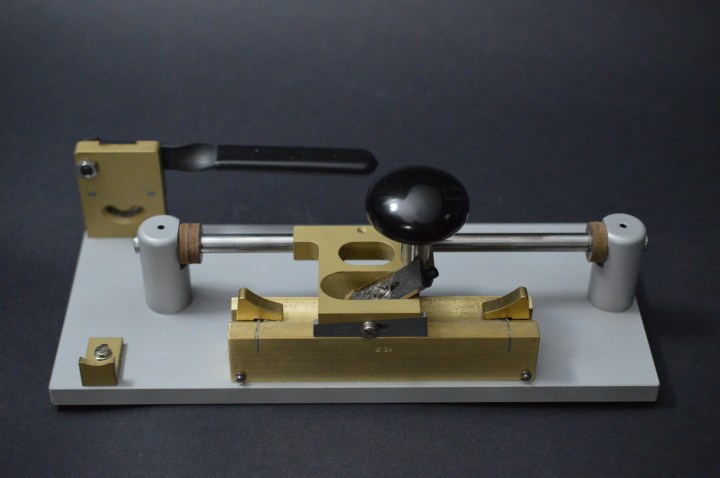
This machine is an ANTIQUE! It is very old and I found it on eBay from an oboe player who had it in his closet for a few decades. This machine represents a very simple single barrel profiler with two basic adjustment screws, a removable blade, and no measurement systems whatsoever. There are many simple machines like this still being done by a few companies. What I like is that it is very easy to use, easy to remove the blade to sharpen myself and easy to adjust. I don’t like that when I adjust the profile I have to waste a few pieces of cane on trial and error experiments with no way of knowing what my current settings are. I found this for $300 and it works great, if you can find a cheap simple profiler you can probably get a good blade fit to it and get it working. Otherwise I would suggest finding something newer and more sophisticated.
Reeds ‘n Stuff Tip Profiler
bassoon tip profilerbassoon tip profiler
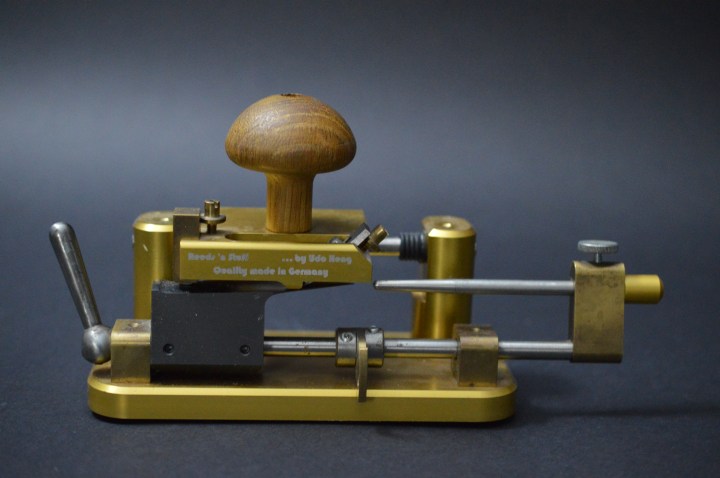
This tip profiler I also found used. This is the only thing that I own by Reeds ‘n Stuff and I’m quite sure that he now makes a fancier version of this. However this is very similar to the Reiger tip profiler and it makes all reed finishing a dream. Every tip is the same every time. I cannot enough stress how much this machine changed my reed making and my consistency of sound. I know that they also make oboe tip profilers, that is most of what I hear oboe reed makers complain about is creating an even tip. I have also had some luck using this with contrabassoon reeds without even having to adjust it. If I just put the reed on and keep it a few millimeters shy of the guideline, I get a great tip.
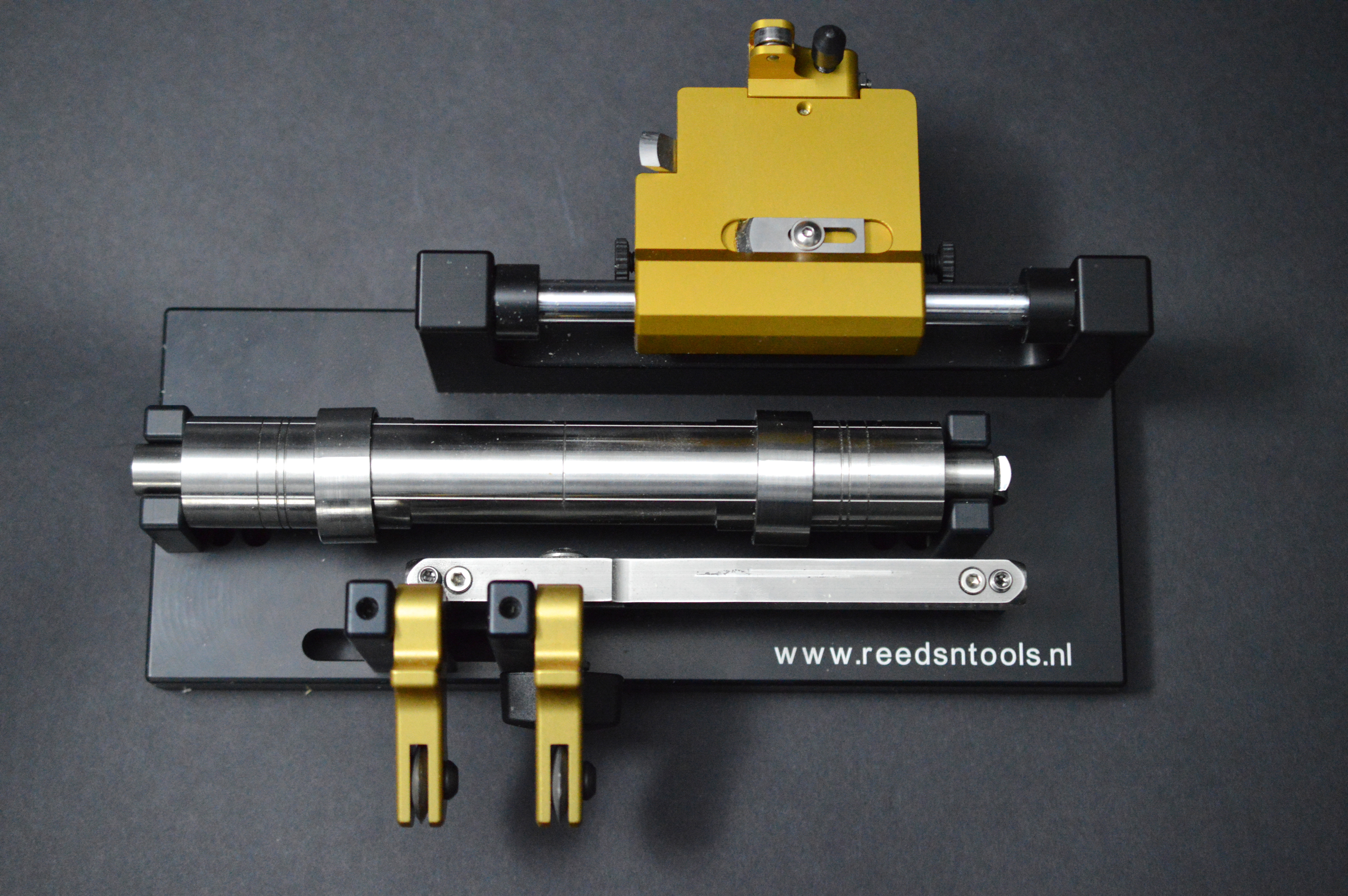
These Reeds & Tools machines are my newest additions, just over a month old. They represent the fanciest machines with flexibility and technology and controlled results. The gouger I currently have set up for processing contraforte cane, this means that I am using a 160mm long 30mm diameter cane bed with a 30mm diameter blade. The cane beds on this machine are interchangeable, so I also have a contrabassoon length bed (150mm) that I can slide use. I also have a 28mm diameter blade and carriage If I want to have eccentrically gouged cane instead of concentric. This machine can also fit a bassoon cane bed, so for doublers who only want one machine to process both instruments’ cane this may be a good choice. Again the guillotine has been great and the bed hold cane firmly.
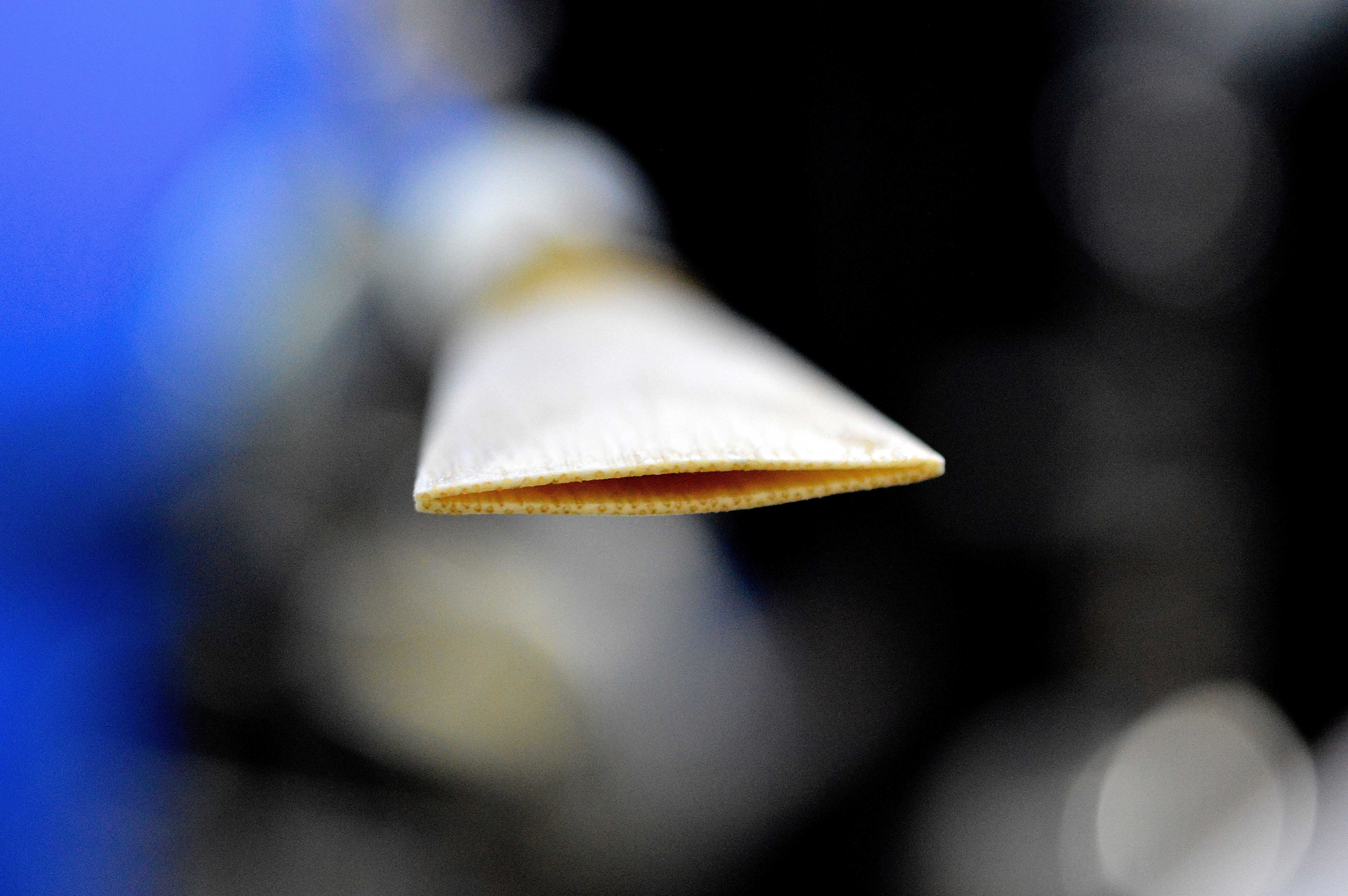
This is an example of the gouge from this machine.
Reeds & Tools Profiler
contrabassoon contraforte profiler
contrabassoon contraforte profiler
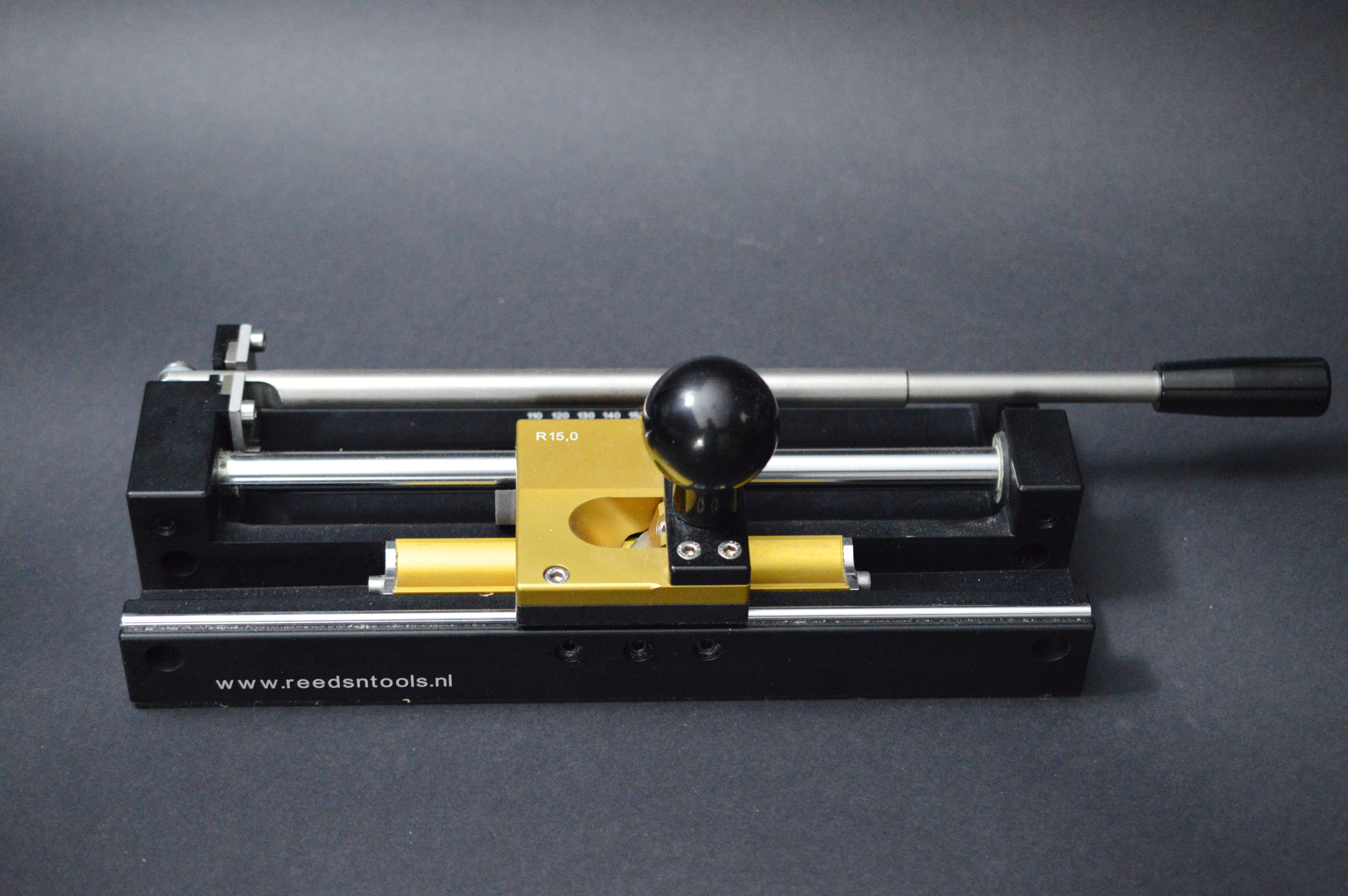
This machine is a blast to use! So easy and fast. I have two scoring blades so I can score the collar and the center line of the cane. Chris van O’s was also nice enough to include a spare blade and a dial indicator for adjustments. Unlike my bassoon profiler, this machine has it all. I can accurately change my profile by hundredths of a millimeter by using the attachable micrometer…
contrabassoon contraforte profiler
This pair of machines make cane processing fast and accurate, and I would recommend them. So far Reeds & Tools is the only company making equipment for contraforte. The machines that I have are for cane up to 160mm in length but he is also making machines at 170mm and 180mm for contraforte player who want to experiment with longer tubes or blades.