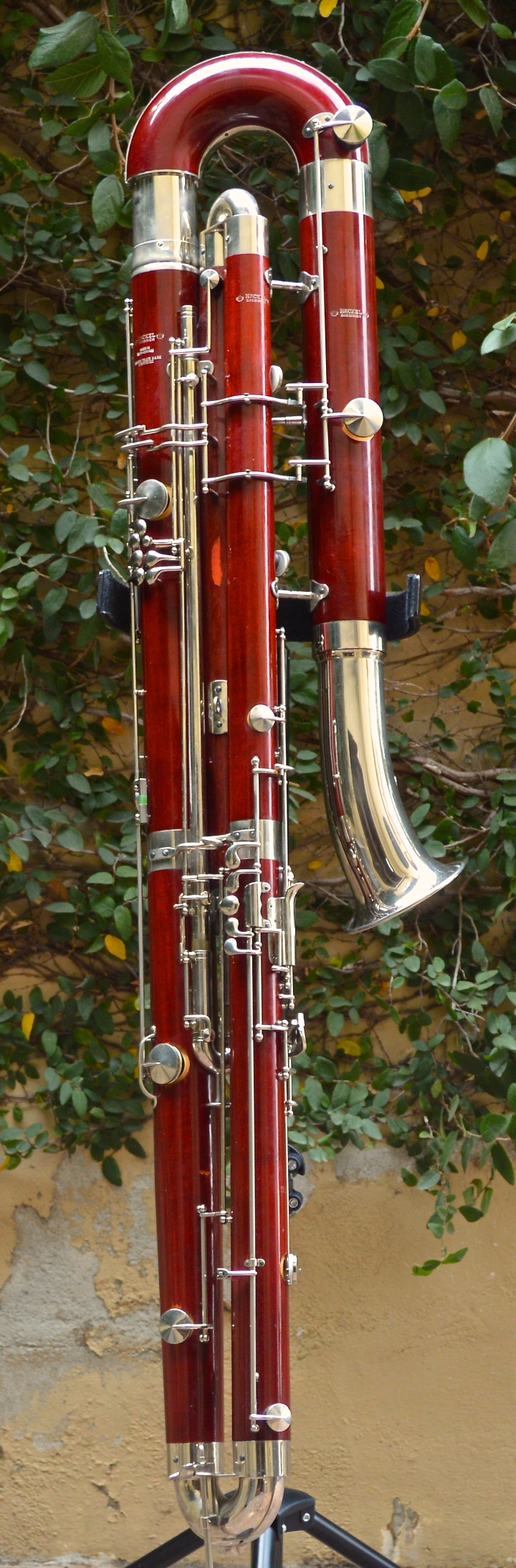
A Contrabassoon has entered my life recently and I am very excited to start using it. This instrument was owned by Steve Braunstein. He ordered it from Heckel while he was playing with the Toronto symphony, it was finished 1984. Over the summer I trialled 2 other Heckel contras and this instrument was by far the standout. I am very lucky to be the custodian of this horn for a few years.

I get asked about the Contraforte vs. Contrabassoon and I mostly stay quiet. But I think that the entire repertoire is accessible to either instrument. I would like to experiment with using both instruments this season, choosing the instrument that fits the character of the piece.

St. Louis Symphony is auditioning Contrabassoonists. The audition is on May 1 and the position starts August 2016. The symphony recently posted the repertoire list, but not yet the sheet music. I’m posting it here because I think it’s useful for people who aren’t taking the audition to see what is on the list. As a student I used to prepare audition lists as if I was going to attend.

The exposition of the second movement of the Mozart Concerto is asked which isn’t typical. Also multiple Shostakovich excerpts are on the list which can be hard to get a hold of.

St Louis Symphony

french whisper key

The little finger whisper key, or french whisper key; should become a standard key on the bassoon. It adds an extra option besides the whisper key lock and reduces fatigue in the repeated transition from low note thumb position to the flick key thumb position. The first example  comes from Robert Rønnes book “12 Virtouso Studies” in the first study “Warming Up” This passage is a good example of the low register to middle register thumb shift. The left thumb need to shift from the low C key across to the whisper key. However  with the little finger whisper key, you can hold down the whisper key for the entire measure. This allows the left thumb to stay in the low register position and play low C as it comes. By using the french whisper key there is the option of quickly removing it, unlike the whisper key lock. It can be added or removed during a fast passage without a reach or shifting.

Rønnes

The next example comes from Simon Kovar’s “24 Daily Exercises” and is a more common issue on the bassoon, the shift from the whisper key to flick keys. The usual technique is to leave the whisper key slightly early in order to get to the flick key in time. With a french whisper key a passage like this takes minimal energy with greater accuracy.

Kovar

Contraforte Reed

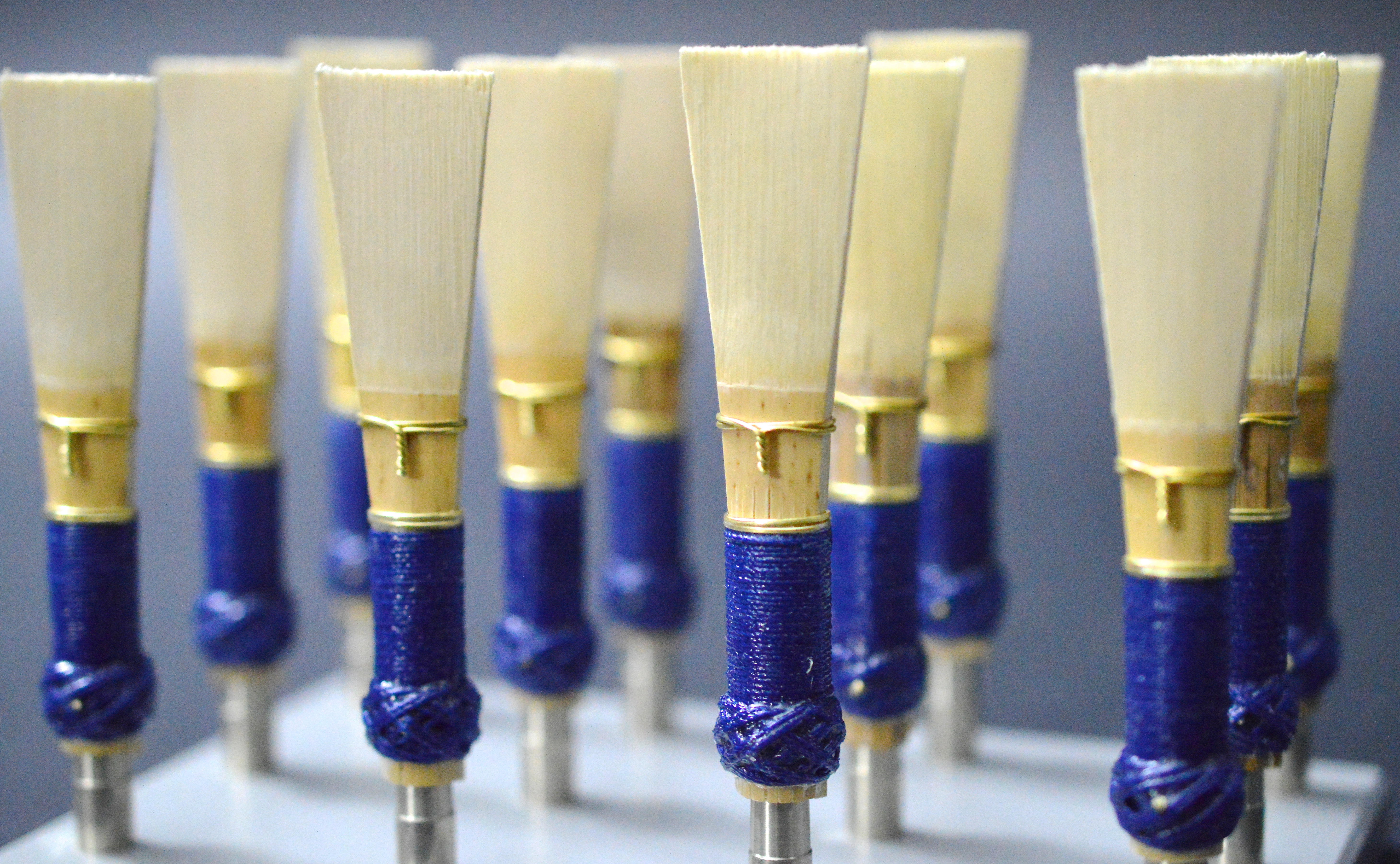
This isn’t an IDRS journal but I think it is still an appropriate place to post reed dimensions. I have only had a few months with the contraforte so far I have come to two styles of reed. One wider and one narrower, the wider shape is a real robust contraforte sound and the narrow shape is a simpler contrabassoon sound.

The wide shape is using the Reiger contraforte shape (23.25mm wide) and formed on a Reiger contraforte mandrel.

160mm cane

35mm blade (collar to tip)

45mm tube (collar to end)

5mm from first wire to second wire

The narrow reed is shaped on a Reiger K1 contrabassoon shape, it’s important to use a fold-over shaper for this since I still use 160mm cane. 160mm cane will not fit into a contrabassoon straight shaper which is meant to hold 150mm cane, but on a fold over shaper the tube continues further. Using this extra tube length also allows the reed to be formed on a contraforte mandrel. Besides using a different shape all of the dimensions are the same.

160mm cane

35mm blade (collar to tip)

45mm tube (collar to end)

5mm from first wire to second wire

contraforte reed

The narrow reed is essential to making the CF work in every situation. This style produces a simple, dryer sound, requiring less air, and achieves an easy pianissimo response.

the wide reed is now available on kingbassoonreeds.com


I get a big kick out of experimenting with my setup and trying different options. Leitzinger bocals have been around for a few years now, and I have only heard good things about them. I play a Fox 601 which has the benefit of being very flexible, the bocal that I use completely changes the instrument.

I’m very spoiled in that I live in San Francisco and pretty close to Forrests Music. I picked up a few Leitzinger bocals to play test for the week and I decided to try different platings and different alloys. When I try bocals, two bocals of the same model and size sound so different.  I don’t usually try different platings because I can’t tell if the difference is between the platings or just different bocals. I ended up with a N ML 1

Leitzinger Bocal


contraforte stand
contraforte stand

After a long search,  I have finally found an instrument stand for the contraforte. This was a find off of eBay and it was made by Aureum. This seems to be a generic low-woodwind stand that can adjust to fit many different instruments, it certainly fits contrabassoon on top of contraforte. The top of the stand is completely adjustable in height, width, and angle that it hold the contra. My only complaint would be that the peg cup at the bottom of the stand is too small, but I might remove it and add a different one.

I am unable to find out where this stand can be bought. It’s a company in Korea and I don’t think that they have any U.S. distributors. I have seen a few of these pop up on eBay though!

contraforte stand

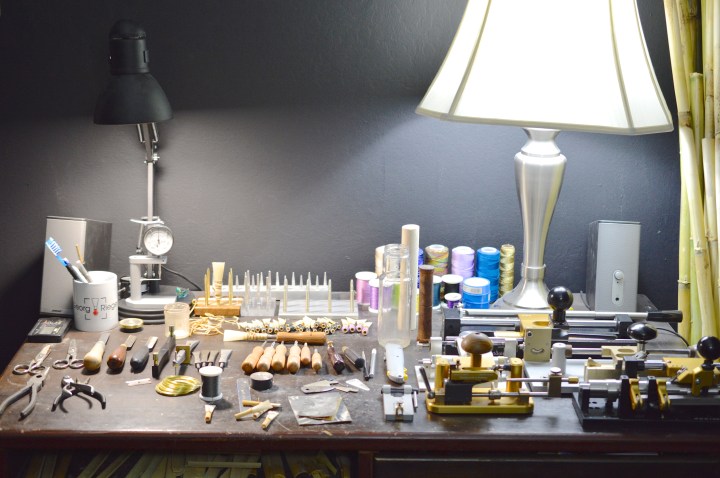
Kris's Reed Desk

The next few entries that I would like to post have to do with my reed desk. I firmly believe that the quality and reliability of someone’s reeds is directly affected by the quality of their reed tools. Generally I have found that people who have great reeds on a daily basis without any “reed panic” days tend to have great reed tools that are sharp and in adjustment.

I would like to post a few entires on a consumer level giving detailed reviews of some of my machines and products. This will be bassoon, contrabassoon, contraforte, or general purpose double reed equipment. I have no affiliation with any company but have chosen my equipment based on reviews, function and the recommendation of my teachers.

20140113-202628.jpg

I just bought a Snark tuner to try out. Many of my colleagues have it and they have nothing but positive things to say about it. I have had clip on tuners before, or at least an extension to plug in to my regular tuner.

The Snark is very quick and responsive, there is no lag time waiting for the tuner to focus on the pitch. There are settings to either pick up vibrations directly from the instrument or to pick up sound through the microphone. The pitch level can be calibrated from 415-466.

This tuner is great for bassoonists because it can easily clip onto the bocal, or onto a oboe/clarinet bell. I actually purchased this tuner for my contraforte and like most tuners it cannot register the lowest octave. That would be my only drawback.

Bocal Collection

Like many players, I am always on the hunt for another bocal. When I was first getting good at the bassoon I was very happy with my sound and then i tried a new bocal and my sound was all of the sudden SO much better. I think that experience created new way of thinking, that there is always a richer more vibrant sound that i can achieve.

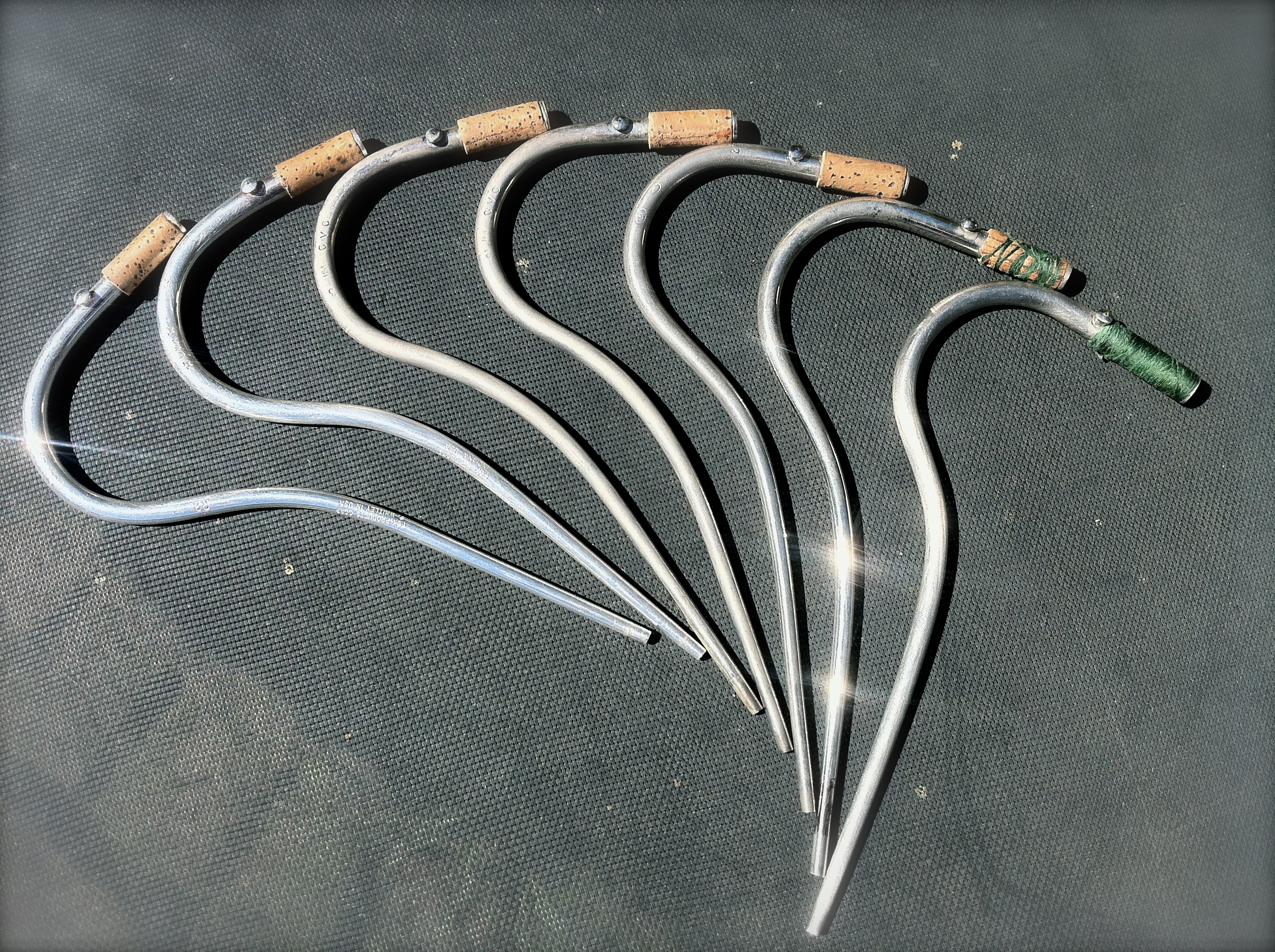
So now I have a bit of a bocal collection going. I really only use one bocal everyday and then I have some specialty bocals. I have: Fox *CVX*R2, *CVX*2, CVC2, CVC3, C and then a few no name bocals that came with my student instruments. I am not a very big fan of Fox bocals but when i try a batch of them i usually find a good match in there. Fox bocals have also in my experience been the most consistent. I have had a few used Heckel bocals sent to me on consignment and there is a drastic different between two bocals of the same model.

I purchased a Fox *CVX* R2 last spring and so far it has been the best bocal I have paired with my Fox 601. It has very little resistance and great pitch control for low notes. The high notes are a little harder to get out than on my *CVX*2 which is the only reason i have a *CVX*2. My two CVC bocals came with my current bassoon and for me they aren’t as vibrant as i would like them to be, they tend to be a little muffled and don’t have the high notes.

I am VERY lucky to work down the street from Forrests Music. After work or on lunch breaks I often go over to test used instruments and bocals. I have gotten the chance to try out the Paraschos bocals and the Leitzinger bocals.  The Paraschos bocal comes in two forms, one as basically solid wood and the other lined with metal. In my experience the Paraschos lined with metal seems to be more resonant and the solid wood version muffles my sound. These bocals are also new so I’m not sure how long their live expectancy is (cracks etc.) Now the Leitzinger bocal is another recent addition or at least in the last few years. There are so many different specifications for these bocals; alloys, length, bend, plating and taper. I haven’t gotten to try all of the different options by far but for the few bocals I tried they seem to be very open and vibrant. Easy playing in all ranges but again i think certain models are better suited for the highest playing. Id seriously consider a Leitzinger as my next new bocal.

Last week I tried the Leitzinger bassoon as well, it seemed to me like more of a gimmick. Like they have great bocals and now they made a “bassoon to match.” It’s priced “competitively” at $24,000. I only got a few minutes with one, and I know that we are all used to our own instruments but the pitch and projection wasn’t even as good as a Fox 240. The f# and g# keys also must have been drilled incorrectly because anything involving those two keys was uncontrollably sharp and had far too much resistance.

These bocals can be found new or used (on consignment):

http://www.forrestsmusic.com

http://www.rdgwoodwinds.com

http://www.charlesmusic.com

http://www.millermarketingco.com